Dynamic Visual Cryptography
Think of it like a special movie that only human eyes can properly see, but with some unique security features.
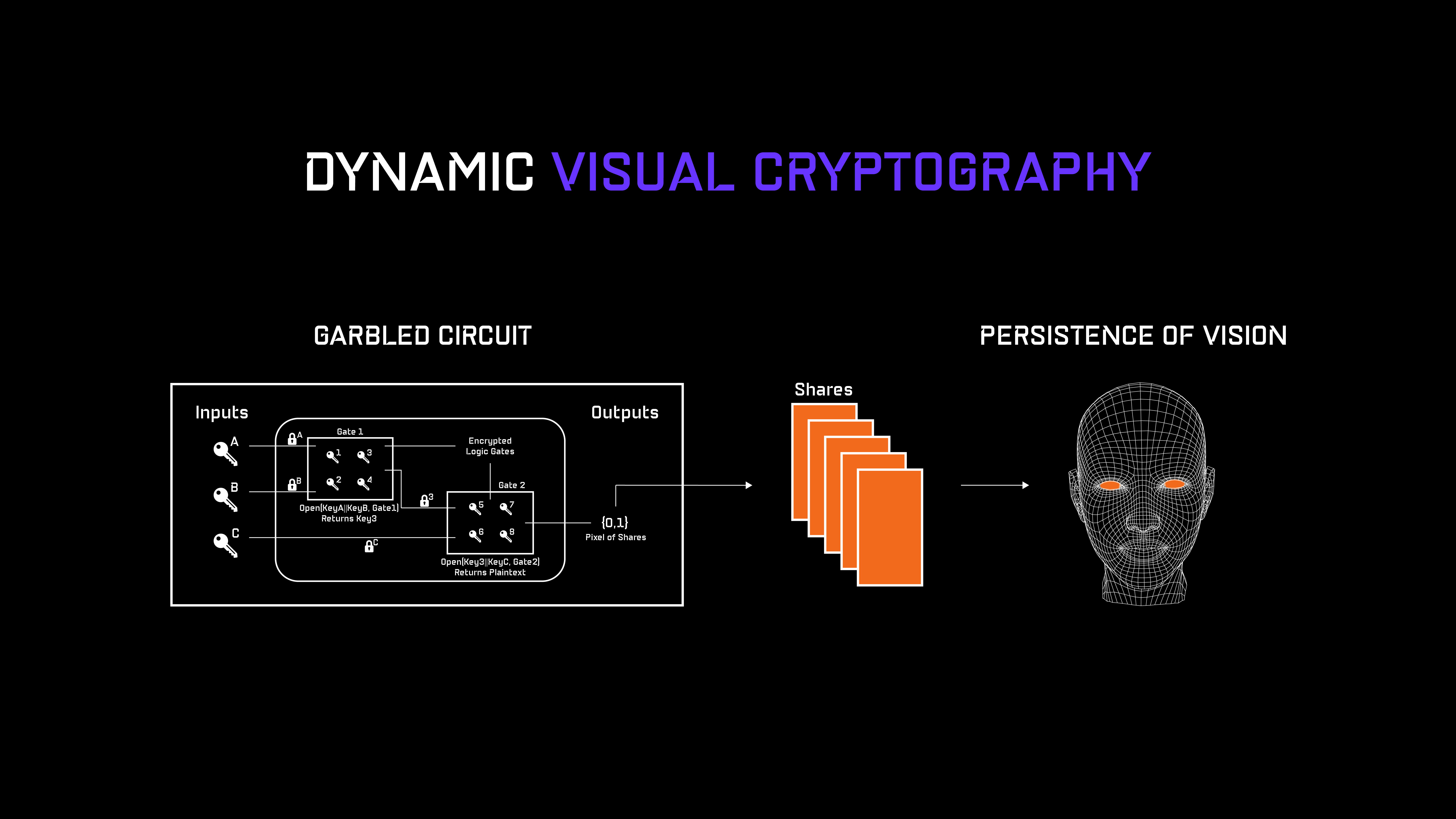
Frame Generation
Each "frame" of the movie is created by a one-time garbled circuit generated on the Interstellar blockchain.
Garbled circuits work like secure black boxes:
- They receive encrypted random inputs
- Process them without revealing internal logic
- Output only the specific frames they’re designed to create
Every frame is cryptographically unique and cannot be reused.
Human Vision
The system uses a human brain feature called persistence of vision:
- Your eyes retain an image for ~1/30 of a second
- When frames change rapidly (60–120 fps):
- Your brain merges the sequence into one coherent image
- Machines see static frames
This creates a channel that only humans can perceive and decode.
Security
All intent data is embedded directly into the garbled circuit, never appearing in memory.
To compromise it, an attacker would have to do all:
- Compromise user device and get rootkit access
- Know exactly when the user intents to initiate an operation
- Capture every individual intent screen frame perfectly (while user already starts confirming otp)
- Precisely reassemble every single pixel of the intent screen
- Mimic the exact display timing (60–120 fps)
- Syncronize everything perfectly in real time (time window of 2-4s)
The system performs real-time probabilistic verification to ensure that user responses correspond to the authentic, currently displayed sequence. Randomized visual watermarks embedded in each frame prevent replay and precomputation attacks. Even if such an attack were theoretically possible, its economic incentive is negative: the attacker could, at best, compromise a single random transaction, without any access to the private key.
Analogy: The Flipbook
Imagine a fast flipbook where:
- Each page is generated by a secure black box
- Each page looks like random noise
- Only the human eye sees the real image when flipping quickly
- Each book is a one-time use and randomized
Basic Simulation
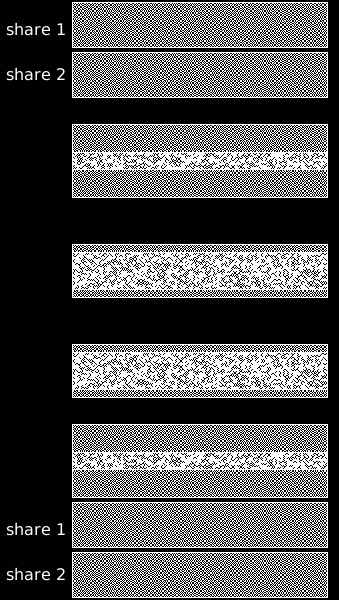
Below is a basic demonstration of visual cryptography.
When two same-sized images of apparently random black-and-white pixels are superimposed, the Wikipedia logo appears.
Interstellar's Dynamic Visual Cryptography
This is the way Interstellar leverages human perssistence of vision with a basic visual cryptography scheme.
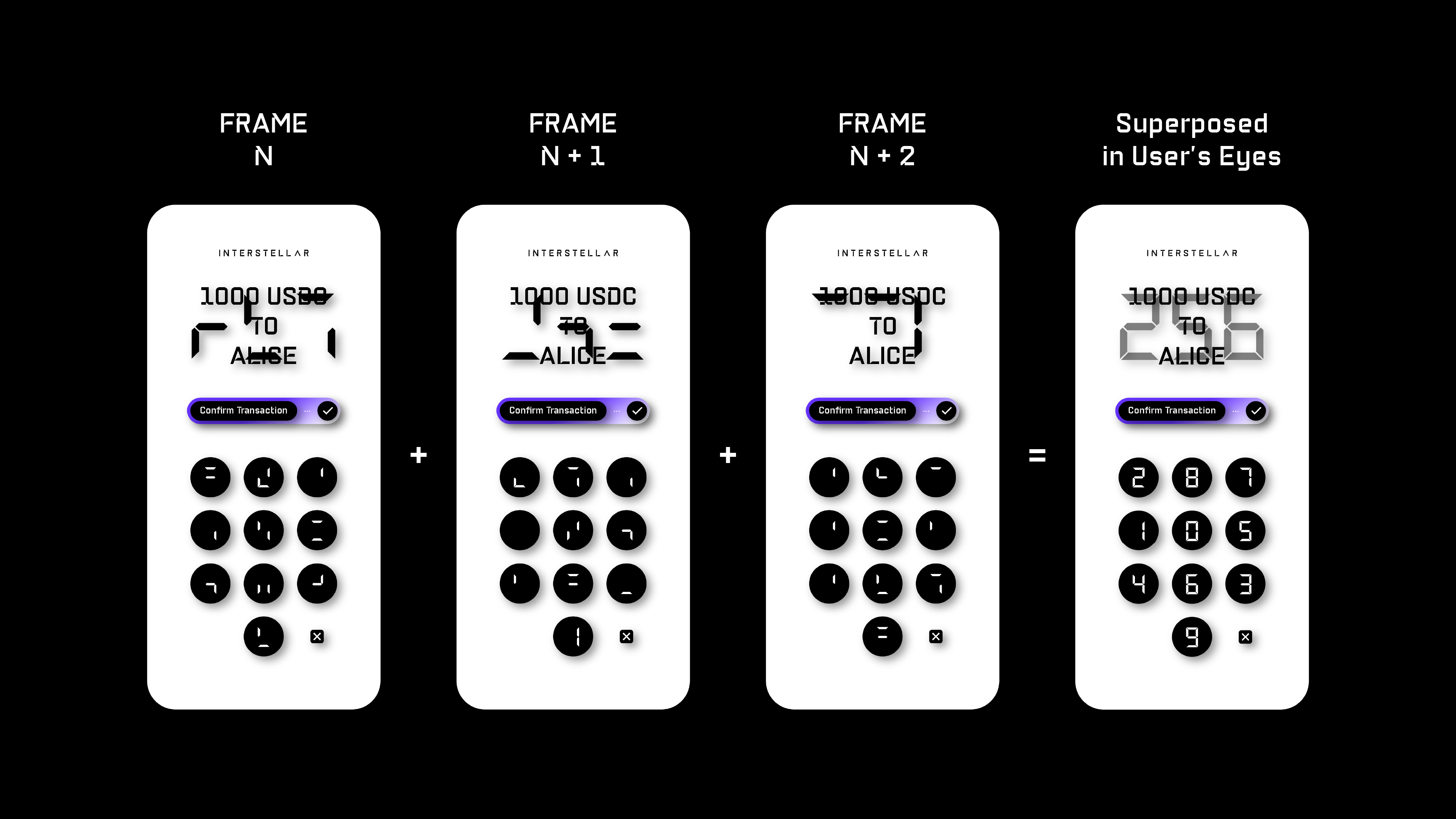
The garbled circuit manages the consecutive random frames display. This ensures that the circuit execution does not leak any secret information, such as the one-time code or the random keyboard topology associated with the transaction. The transaction message — amount, address, intent — is also embedded into the circuit, remaining inaccessible to attackers, preventing any modifications. This creates a secure visual channel between the blockchain and the user.
Garbled Circuits + Human Biology = Secure UI
This secure display channel:
- Prevents overlay attacks and clipper malware
- Makes tampering visible
- Works even on infected devices
- Makes transaction spoofing ineffective
Instead of detecting malware, it creates an environment where spoofing is useless.
Deep Tech Advantage
- No need for kernel access or malware detection
- Secure even on compromised devices
- Simpler and clearer than traditional mobile EDR solutions
This technology enables hardware-wallet level security with nothing more than your smartphone.